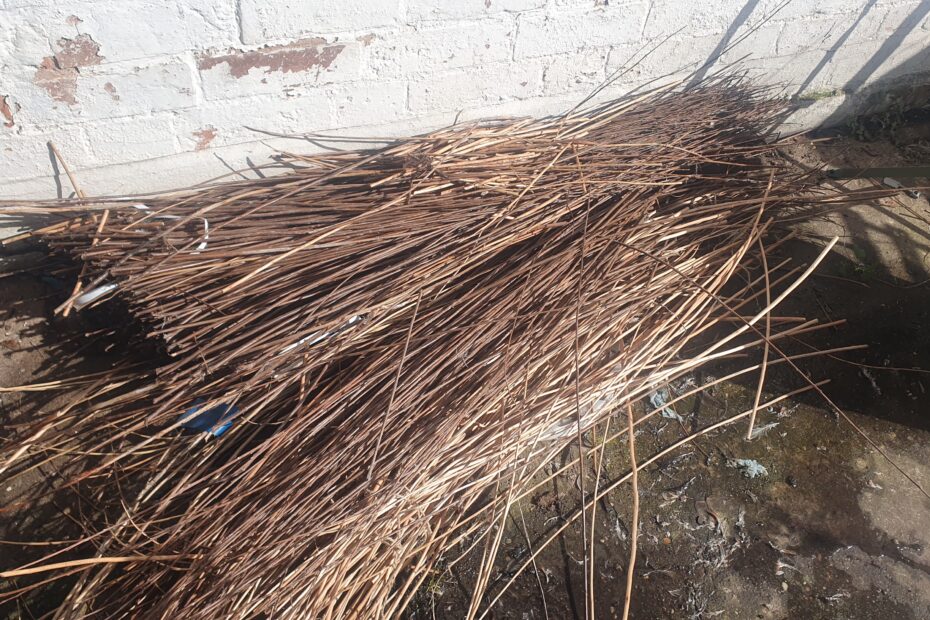
We were delighted this week to receive a generous donation of dried willow wands from our friends Sustainable Life Birmingham, supporting our upcoming Food and Fire in Ten Acres project.
At first glance, these willow rods might not seem like much—lightweight, dry, and no longer suitable for weaving—but to us, they are a valuable and thoughtful contribution that will play an important role in what we’re creating.
Willow is a wonderfully versatile material, widely used in traditional crafts like basketry and living structures. However, once willow has been soaked and used for weaving, it loses the flexibility and strength that make it suitable for crafting in the first place. As it dries out again, it becomes brittle and prone to snapping, meaning it can’t simply be reused in the same way.
This is often the point where materials risk being discarded—but it doesn’t have to be the end of their story.
For our Food and Fire in Ten Acres project, these dried willow wands are perfectly suited as fire kindling. They’ll be especially useful for keeping our Kelly Kettle going, helping us provide plenty of hot cuppas throughout the sessions. It’s a simple but meaningful way to give the material a second life—reducing waste while keeping things warm and welcoming for everyone involved.
This donation also highlights an important aspect of woodland management that often goes unseen. Dead wood plays a vital role in woodland ecosystems. It provides habitat for insects, fungi, and small animals, contributes to soil health, and supports biodiversity in countless ways.
However, like many natural resources, it needs to be used carefully. Removing too much dead wood from a single woodland can disrupt these ecological processes and reduce the benefits it provides. That’s why it’s so important to strike a balance—retaining enough material on site to support wildlife, while sourcing additional wood responsibly when projects require it.
By bringing in this donated willow, we’re able to protect the ecological integrity of our own woodland spaces while still having the materials we need to deliver Food and Fire in Ten Acres. It’s a simple but powerful example of sustainable practice in action.
We’re incredibly grateful for this contribution. Not only does it support our work in a practical sense, but it also reflects a shared ethos—valuing natural materials, reducing waste, and working in harmony with the environment.
We’re looking forward to putting these willow wands to good use and can’t wait to share more as the project develops.